It’s 2026, and the SaaS battlefield is a war zone like never before. In such a Competitive marketplace, having an awesome product is merely half the battle when considering your saas marketing budget. The remaining half is ensuring folks actually find it. And that’s where the requirement for a properly planned SaaS SEO budget comes in. This also becomes highly relevant considering the talk of the whole AI taking over SaaS and everything else. Having a planned budget is extremely critical for any SaaS business.
Unlike paid ads, where the immediate impact disappears once you stop spending, SEO/AEO/GEO builds a foundation that keeps delivering results and compounding year over year. SaaS companies can purchase high-intent users who already have a need and are searching with the right budget, without spending money every time they want to try an ad, which can drive up their CAC (customer acquisition cost).
On the other hand, SaaS businesses that ignore SEO, including local seo, lag behind. Optimization and ongoing improvement allow competitors to capture SERPs (search engine results pages) & LLM mentions that build trust with the users. Early resource allocation and natural search can be your most reliable source of growth.
Key Takeaways
- Plan Smart: Don’t put all your money in one place. Divide it between content, website fixes, technical seo, links, and tracking, so everything works together.
- Quality Wins: It’s extremely critical to write a few really good blogs or guides rather than dozens of average ones. People trust useful content.
- Fix the Basics: Make sure your site loads fast, works well on mobile, and is simple to use. If your site is slow or messy, nothing else will work.
- Think Ahead: New things like voice search, image search, and Google’s trust rules are growing. Get ready now so you’re not left behind later.
- Track Results: Always check what’s working, see where your traffic and sales are coming from, and see what’s wasting money
- Don’t Waste Money: Avoid paying for useless content or short-term fixes. Balance your spending so it helps long-term growth.
What does SEO mean in a SaaS business?
SaaS SEO refers to the process of optimizing a Software-as-a-Service site so that it can reach, connect with, and convert organic leads via search. SaaS SEO is not like regular SEO, which is all about quick e-commerce sales or blog monetization. SaaS SEO is more about lead generation, triggering demo requests, and establishing long-term relationships with customers. SaaS SEO is typically a long-cycle process, which takes about 9-12 months of serious work before you can start establishing any kind of funnel.
SaaS companies have unique conditions that make Local SEO and traditional search engine optimization less effective. Longer sales cycles, subscription pricing, and technical target markets mean the content can’t just demand instant purchases. It must educate, build, and guide leads, each page addressing pain points and demonstrating product value through content marketing along the way.
By executing the proper plan, well-tailored SaaS SEO strategies can take a brand to the top of its niche and build long-term growth. Combined with fine-tuned technical optimization, smart content planning, and user-centric keyword targeting, search traffic can be an ever-replenishing source of high-quality leads, generating short-term interest and long-term loyalty. It also helps in building the topical authority, which is one of the most critical aspects of getting organic traffic.
Why SEO Marketing Budgets are important for SaaS?
The SaaS industry in 2026 is extremely competitive, with new software products being released every day in every niche. Without SEO, even highly rated products won’t be seen by the people who can buy them. A successful budget plan invests in ways that bring visibility, quality leads, and improved search rankings through the help of seo services from a saas seo agency compared to competitors.
While paid advertising can drive traffic in a limited time horizon, it can be stopped the moment the ad budget runs out, but SEO becomes more powerful and compounds every day. Every well-optimized web page, blog entry, or landing page continues to attract users months and years after the content has been created. While mentioning this, paid ads are a separate channel that works really, really well. However, the way to look at this is – Organic is a more long-term play and moat, and paid ads give you immediate results and let the product out fast in the market, and it also gets more and more expensive by the day.
By smart planning and execution, SaaS business companies can attain maximum ROI through an effective seo campaign. Each dollar invested goes toward making good, long-term progress.
What is the Average 2026 SaaS Search Engine Optimization Budget?
With the average budget for 2026, companies can properly plan their resources and stay competitive. Most small SaaS businesses have minimal marketing budgets and spend $500–$3,000 per month on SEO. 5–10% of the marketing budget should go towards fundamental tasks such as keyword research, on-page optimization, and simple content creation.
Mid-sized SaaS businesses, which desire quicker growth and broader coverage, invest $5,000–$15,000 annually in SEO. Typically, it represents 8–12% of their marketing budget, and it consists of content strategies with higher levels, competitor analysis, technical SEO audits, link-building programs, and technical SEO optimization. This budget ensures a long-term investment and reliable ROI from SEO, driving both lead generation and authority building.
Enterprise-level SaaS businesses pay massive amounts of money, typically $11,500 to $21,500 per month or 10–15% of their overall marketing budget. These funds complete program SEO projects that contribute to annual recurring revenue, including necessary seo audits, such as international SEO, cannibalization audits, deep technical seo audits, LLM mentions & citations tracking, and enterprise-level analytics.
A thoughtfully designed SEO budget ensures organic search keeps on delivering qualified leads, reduces paid ad dependence, and upholds market leadership.
SEO Campaign Budget for 2026: Where to Invest for Maximum Growth?
A well-planned SEO budget makes every dollar count by boosting visibility across various marketing channels, attracting high-quality marketing-qualified leads & opportunities, and fueling long-term growth.
Let’s take a closer look at the most critical areas where SaaS organizations must put their SEO spend.
1. Content Creation: Blogs, White papers, Case Studies
Content is the backbone of well-designed SEO. Well-written blogs with original content & insights, in-depth white papers, and engaging case studies not only drive organic traffic but also lead prospective customers through their buying journey. The marketing strategy focus is always on solving real problems, addressing pain points, and making transparently clear the value your product provides.
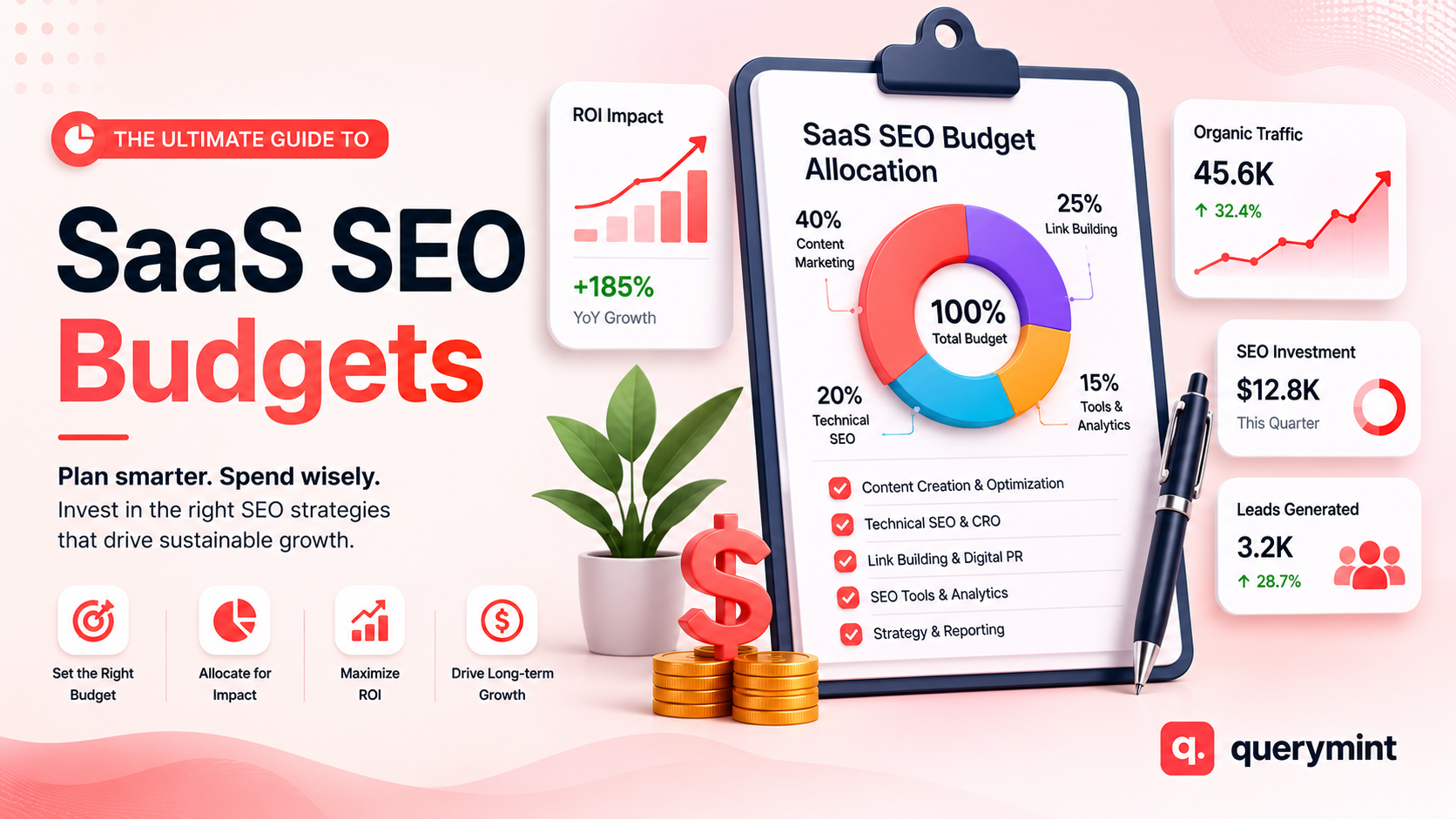
Content absorbs 30–50% of the SEO budget across most SaaS companies. Periodic publication of high-quality content, supported by effective seo tools, builds authority, improves rankings, and generates consistent leads. Utilize SEMrush, Ahrefs, or QueryMint to uncover keyword gaps and opportunities so that your content hits the target audience.
2. Link Building & Digital PR: Guest Posts, Partnerships, Outreach
Backlinks still remain and will most likely remain one of the strongest SEO/AEO/GEO indicators. For SaaS businesses, digital PR plays an enormous role in building credibility. Guest posting, joint ventures, and outreach initiatives place your content in front of the right audience while earning invaluable credible backlinks.
Most often, 20–30% of the SEO budget goes here. Best, most relevant links not only improve domain authority (DA or DR) and rankings but also deliver referral traffic with a likelihood of converting to paying customers.
3. Technical SEO & Website Optimization: Site Speed, Schema, UX
Even the best content will fail if your website is not technically sound. Speed optimization, the addition of structured data (schema), and a seamless user experience are critical in making search engines, LLM crawlers and users smile, especially when compared to PPC budgets.
SaaS companies would spend 15–25% of the budget on technical SEO. Regular audits with tools like Google Search Console, Screaming Frog, or QueryMint’s Technical SEO Module can be done to fix broken links, duplicate pages, and slow speeds, improving the experience and your content’s performance, ultimately driving SEO / AEO conversions.
4. Tools & Platforms: Ahrefs, SEMrush, QueryMint, Surfer, etc.
The right tools save time and offer guidance. Tools like Ahrefs, SEMrush, QueryMint, or free seo tools provide insights into competition and other marketing channels, keyword potential, and content performance, allowing teams to work smarter, not harder.
10–15% of the SEO budget, on average, goes to tools. Investments allow your team to monitor performance, find new opportunities, and make data-driven decisions that equate to better ROI.
5. Analytics & Reporting: Monitoring Traffic, Conversions, and ROI
Monitoring performance is just as important as the work itself. Monitoring organic traffic, keyword trends, and conversions informs most businesses about what is performing and what needs to be adjusted.
SaaS businesses typically allocate 5–10% of the SEO budget to this. With tools such as Google Analytics, Search Console, and Data Studio, and in collaboration with a search engine marketing agency, you can monitor ROI, refine strategies, and ensure every dollar fuels expansion.
By investing your budget wisely in content, links, tech optimization, tools, and analytics, including help from a search engine marketing agency, businesses can create a lasting organic growth engine. Everything is aligned for visibility, authority, and long-term success in the crowded SaaS market.
Watch this – https://podcasts.apple.com/il/podcast/saas-interviews-with-ceos-startups-founders/id1023761733
How to Calculate the Right SEO Budget for SaaS?
Picking the right budget is intimidating, but easy with a structured approach. The aim is to pay enough to generate substantial organic traffic without going over budget, while aligning SEO with your growth objectives.
The following are three feasible ways of budget estimation, as proposed by your seo specialist.
1. Revenue-Based Formula
A pay-for-performance strategy ties SEO investment to your business revenue. Most SaaS businesses earmark 2–10% of yearly revenue for SEO, contingent on growth objectives and competitiveness within the marketplace. A business with $1 million in revenue, for instance, might commit $20,000–$100,000 every year to SEO initiatives.
This approach ensures the investments in SEO are aligned with what the business realistically can support. Competitive high-growth SaaS companies tend to fall toward the upper end of this spectrum in order to accelerate market share and drive organic leads.
2. Percentage of Total Marketing Spend
This approach is used to make the SEO investment commensurate with the investment that the firm can afford. Competitive growth SaaS companies tend to be towards the top end of this scale in hopes of gaining market share traction and of establishing organic leads.
Another method applied is to allocate the SEO expenditure as a percentage of overall marketing spending. For SaaS businesses, it is typical to allocate 20–30% of their online marketing spend to SEO. The proportion allows firms to achieve the proper combination of paid advertising, social marketing, and SEO and reap the rewards of successful, diversified marketing spending.
3. ROI-Centric Calculation
The most strategic budgeting is ROI-oriented budgeting. Begin with the calculation of the customer lifetime value (LTV) and the cost to acquire a customer (CAC). Your budget should be able to acquire organic leads at a CAC of less than their LTV to achieve profitable growth.
For instance, if it costs $200 to get a paying customer with SEO, and the customer is worth $1,000 in their lifetime, the ROI makes sense. Tracking and tweaking according to performance metrics keeps your budget always in proportion to business profitability.
What Elements Affect SaaS SEO Budgets?
It is not a one-size-fits-all solution to set a budget. Various elements determine how much money a firm ought to spend on SEO, ranging from company stage to market complexity.
Knowing these aspects enables SaaS companies to make an effective allocation of resources and boost ROI.
1. Company Stage: Startup vs Scale-Up vs Enterprise
A low-resource business can spend its limited marketing budget on essential SEO work such as keyword research and generic content creation. Scale-ups spend extensively to gain market share, e.g., on high-quality content, link-building activities, and tech optimization.
Your business cycle determines not only how large your budget can be but also where to invest in the first place. A new SaaS company may struggle with slow ROI, while established companies reap the benefits of exponentially growing SEO efforts on channels.
2. Market Size & Competition
Your target market’s level of competition directly influences budget allocations. Saturated markets need more expenditure on content, links, and technical SEO, along with thorough competitive research, to surpass others, whereas niche or small markets need less aggressive efforts.
Recognition of your competitors’ SEO methods and market conditions guarantees your budget remains realistic and focused on growth. In the realm of paid search, more competitive markets necessitate constant investment to sustain rankings and visibility.
3. Target Geographies
SEO expense is based on geographic focus. Marketing global or multi-country markets tends to demand multilingual material, area-specific keyword analysis, and native link-building campaigns. Targeting a single market or region may decrease expenses while guaranteeing good results.
Budgeting needs to consider the geographic differences in order to make campaigns effective without overspending, including social media marketing efforts.
4. In-House vs Agency SEO
Whether to do SEO internally or outsource it influences budgeting. Internal staff offer control in exchange for salary, training, and equipment costs. Outsourcing offers experience and scalability for agency costs. Most SaaS companies operate a hybrid model, balancing cost and efficiency with the integration of Google Ads.
By considering firm stage, industry competition, target geographies, and resource management, SaaS businesses can invest their SEO budget to the fullest to spur quantifiable growth and awareness in the long run.
What are the Hidden Costs in SaaS SEO Budgets?
Even the most planned SEO budgets can encounter unforeseen spending, which is why hidden costs are important to understand for any budget. Software like SEMrush, Ahrefs, or Surfer may have subscription rates higher than initially expected, particularly when monitoring several sites or keywords.
Paid guest blogs, digital PR efforts, and sponsored content spaces also tally up fast. Obtaining authoritative backlinks or executing media outreach sometimes involves charges beyond initial cost projections.
Content also needs constant updates to keep rankings and relevance intact. Updating blog content, optimizing landing pages, or producing new resources contribute to continuous expenses. Considering these hidden costs keeps your SEO campaigns sustainable and avoids excessive spending.
How SaaS Businesses Overspend on SEO?
Most SaaS businesses inadvertently overspend on SEO by emphasizing quantity instead of quality across different marketing channels . Expenditures in content creation without proper keyword targeting or user intent can exhaust the SaaS SEO budget without producing significant results.
Overspending is also when businesses spend money on platforms that they don’t utilize to their full capacity. Having overlapping software subscriptions or paying for premium features that don’t improve ROI can unnecessarily increase expenses.
Another mistake is overdependence on paid links or aggressive link building with little long-term return on investment. Businesses that fail to track performance metrics or optimize campaigns often continue spending on low-performing marketing channels, such as LinkedIn ads, thereby reducing overall efficiency and ROI.
2026 SaaS SEO Trends That Affect Budgeting
SEO in 2026 is changing fast. It’s not just about ranking for keywords anymore. With AI tools, voice search, and the need to build real trust, SaaS companies now have to be smarter about where they spend their SEO budget.
1. AI-Driven SEO – AEO – GEO
AI is changing the way SaaS businesses strategize and carry out SEO. AI-powered tools are able to scan big data, provide keyword recommendations, and even come up with content ideas, saving teams time and allowing them to strategize.
Spending on AI-based tools will add a little to your SaaS SEO cost, but it is worth it by making campaigns more efficient and productive. Startups and businesses can leverage AI to pinpoint high-potential opportunities without speculation.
As AI keeps advancing, its use in predictive analytics, content optimization, and competitive research will increase. Investing in AI now will keep your SaaS brand at the forefront.
2. Voice & Visual Search Optimization
Voice assistants and visual search are redefining the way users seek information. Voice query and image optimization can make your SaaS product visible in more search results, engaging new audiences.
Allocating part of your SaaS SEO budget to voice and visual search ensures you’re not missing out on emerging search behaviors. This could include structured data, alt-text optimization, and conversational keyword targeting.
Companies that embrace these trends early gain a competitive advantage. Even small changes, like optimizing FAQs for voice search, can improve visibility and drive relevant traffic.
3. E-E-A-T (Experience, Expertise, Authoritativeness, Trustworthiness)
Search engines are more and more rewarding content that reflects actual expertise and credibility. Showcasing your team’s experience, presenting authoritative case studies, and establishing trust signals enhance rankings.
Part of your SaaS SEO budget must be directed towards producing high-quality, trustworthy content and being transparent online. This might include credible & real author profiles, authenticated testimonials, and thorough documentation.
A focus on E-E-A-T not only increases search rankings but also establishes long-term brand credibility. For SaaS businesses, online credibility means more conversions and lifelong customers.
By allocating your ppc spend to these latest trends, businesses can invest in efforts that provide long-term expansion, remain at the front of the competition, and address changing audience needs.
SaaS SEO Budget Mistakes to Steer Clear Of
Most SaaS businesses spend too much or waste their SaaS SEO budget through a handful of common mistakes. One of the biggest mistakes made by the marketing team is inefficient resource allocation within the marketing funnel. Spending too much money at the awareness stage while ignoring conversion-oriented pages can result in traffic but no actual leads. So, all traffic is not equal, and while TOFU is still relevant and should be built, a very sharp eye on BOFU traffic and which direction it is heading should also be taken care of.
Neglecting technical SEO is the other trap. Slow pages, broken links, or bad site organization minimize the impact of otherwise great content from your seo program, squandering a huge amount of the budget.
Over-investing in low-value content, including generic blogs and poorly researched articles, is also prevalent. Quantity is felt to be productive, but it never provides valuable results. Prioritizing high-quality, targeted content means generating leads and conversions.
Budget Allocation by Funnel Stage
Distribution of the SEO budget based on the buyer journey makes the most of efficiency. During the awareness phase, top-of-funnel material such as blogs, guides, and informational articles drives potential customers. A small share of the SaaS SEO budget needs to be spent here in order to achieve maximum visibility.
At the consideration stage, customers are considering solutions. Budget can be centered around comparison content, case studies, and in-depth guides that guide prospects in comprehending your product value, as well as how to distinguish it from others.
When at the decision stage, SEO activities drive conversions with optimized landing pages, free trial sign-ups, and demo requests. Having adequate resources in this stage ensures that traffic from organic sources will convert into paying customers, achieving the highest ROI on your SaaS SEO budget.
SaaS SEO Budgeting Checklist
Budgeting for SaaS SEO isn’t just about how much you spend, but where you spend it. A clear plan ensures every dollar drives growth instead of being wasted. Here’s a simple checklist to guide your budgeting decisions.
1. Establish Goals
Prior to the application of any resources, there is a need to establish well-defined goals for your SaaS SEO budget. Whether it’s lead generation, revenue growth, or enhancing brand awareness, well-defined goals assist in prioritizing expenditure and effectively measuring success.
Without specific targets, SEO efforts can become scattered, leading to wasted budget and missed opportunities. Defining goals ensures every investment in SEO aligns with your business strategy and delivers tangible results over time.
2. Allocate by Funnel Stage
Spreading your SaaS SEO budget across the marketing funnel provides coverage through your seo campaign at every phase of the customer journey. Awareness-stage content, such as blog posts and guides, draws in potential users, while consideration content, such as case studies, assists them in assessing your solution.
Investments in decision-stage content, such as landing pages, trials, and demos, drive traffic into paying customers. Strategically allocating budget across these phases maximizes ROI and makes your SEO efforts drive quantifiable business outcomes.
3. Quality of Content
Quality content is the foundation of successful SEO. Spend a chunk of your budget for seo producing blogs, guides, case studies, and landing pages that deliver actual value to users.
Prioritizing quality over quantity guarantees content ranks well in search, generates organic traffic, and educates leads through the funnel. Low-value content can eat into the budget without producing worthwhile results, so investing in quality is important.
4. Technical SEO
Having a technically sound website is key to search engine visibility. Spend some of your SaaS SEO budget on site speed optimization, mobile responsiveness, structured data (schema), and user experience optimization.
Technical SEO guarantees your content gets discovered, is easy to use, and ranks high. Not addressing these will discourage organic traffic, diminishing the effectiveness even of the best content.
Reporting on ROI enables you to pinpoint high-leverage activities for your ppc campaign, eliminate waste, and continually optimize your approach. Ongoing monitoring guarantees that your SEO investments underpin sustainable growth.
Summary: Maximizing Your SaaS SEO Budget in 2026
A solid SaaS SEO budget is more than a marketing cost—it’s an investment in long-term growth. In 2025, organic visibility can make or break whether your product gets found or not. Intelligent distribution across content, technical SEO, and link-building guarantees measurable outcomes.
Startups, scale-ups, and businesses all stand to gain with a structured approach. Small businesses concentrate on core SEO activities, whereas larger businesses can spend on programmatic content, global SEO, and specialized analytics. A strategic budget ensures that high-impact activities are prioritized and traffic is turned into qualified leads.
Being competitive involves keeping up with monitoring and flexibility. Budgeting for trends such as AI-based SEO, voice and image search, and E-E-A-T keeps one up to date. Blending smart spend with data-driven insights makes for a sustainable driver of visibility, trust, and long-term revenue.
FAQs
1. What is a good budget for SEO?
A good SEO budget depends on your company size, growth goals, and market competitiveness. For SaaS, small startups may spend $500–$3,000/month, mid-size businesses $5,000–$15,000/month, and enterprises $20,000–$100,000/month, depending on their average growth rate . The key is allocating funds, including ppc budgets, where they deliver the most ROI.
2. How much should a SaaS company spend on marketing?
SaaS companies typically allocate 10–30% of their revenue to marketing. SEO often takes 20–30% of the digital marketing budget, balanced with paid campaigns, social media, and content marketing for maximum reach.
3. How to calculate an SEO budget?
There are three common ways to calculate an SEO budget. Some businesses set aside 2–10% of their annual revenue for SEO, while others allocate a fixed share of their overall marketing spend. A more advanced approach is ROI-focused, where the SEO budget is planned to ensure the cost of acquiring a customer (CAC) stays well below their lifetime value (LTV).
4. What is SaaS-based SEO?
SaaS SEO focuses on optimizing a Software-as-a-Service website to attract, engage, and convert leads organically. Unlike e-commerce or blog SEO, it emphasizes long-term customer acquisition, educational content, and nurturing prospects through longer sales cycles.


